


close
Choose Your Site
Global
Social Media
Views: 0 Author: Site Editor Publish Time: 2026-11-02 Origin: Site


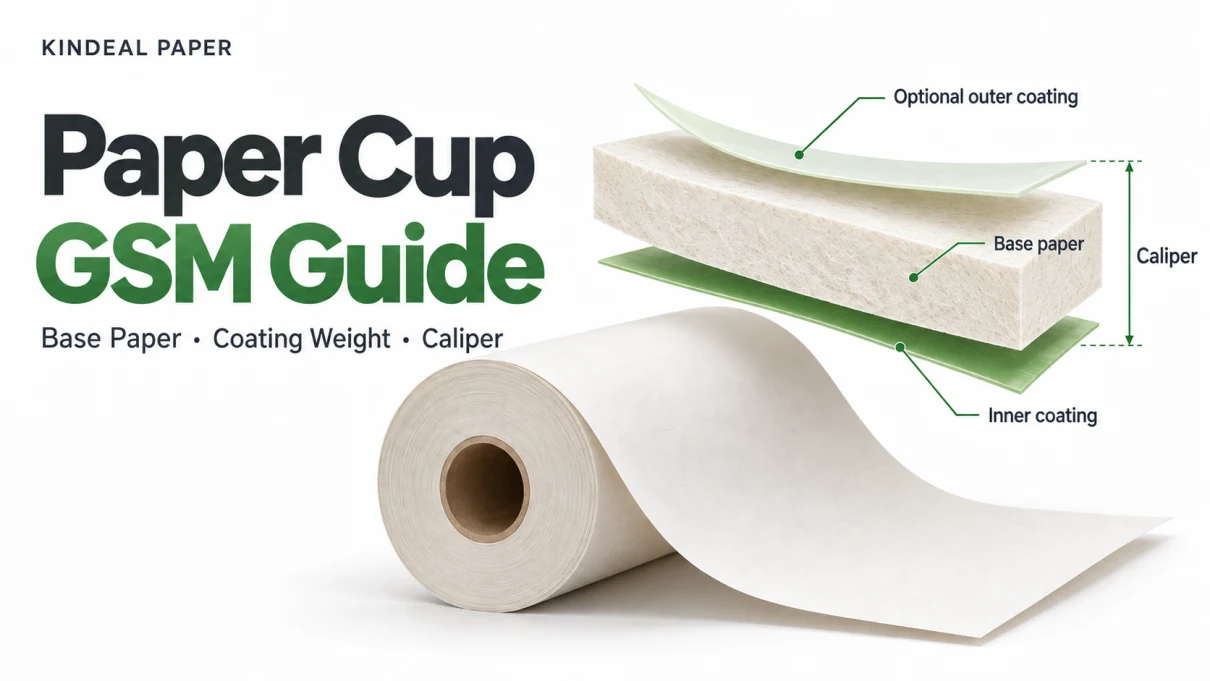
A replacement cupstock can match the GSM on your purchase order and still need a new forming trial. The total weight may be unchanged while the base paper, coating on each side or finished thickness has changed.
Before approving a change in paper cup GSM, ask: will the proposed stock preserve the forming and finished-cup performance you need?
Start with three separate values:
Base paper GSM: The weight of the paper before the separately specified barrier coating.
Coating weight per side: The amount of barrier material applied to each surface.
Finished caliper: The thickness of the supplied coated sheet.
Keep these values tied to an approved material reference so that changes remain visible.
Quick answer: GSM means grams per square metre, or g/m². It measures mass per area. Caliper measures thickness. The coating contributes to total GSM, but its weight does not describe the paper structure underneath.
Specification | What the number describes | What to write down |
Base paper GSM | Paper weight before the separately specified barrier | Grade and nominal base weight |
Coating weight | Barrier material added per unit area | Material, weight per side and orientation |
Total coated GSM | Combined weight of the stated supplied layers | The complete layer breakdown |
Finished caliper | Thickness of the supplied coated sheet | Value in µm and agreed tolerance |
Before comparing materials, clarify these points:
Base versus total: Ask whether "250 GSM" refers to paper before coating or the finished coated stock. The same label is not enough to establish equivalence.
Per side versus combined: Confirm whether "18 GSM PE" applies to one surface, each surface or the sum of both surfaces.
Material stage: Compare base paper with base paper and finished stock with finished stock. A base paper caliper cannot be checked against a coated-stock thickness limit.
Reference methods: ISO 536 addresses paper and board grammage; ISO 534 addresses thickness and related properties. Record the method and material tested alongside the result.
Consider an illustrative substitution review. A factory has approved a single-side PE cupstock. A proposed replacement carries the same total GSM, but its layer breakdown is different.
Layer | Approved reference | Proposed replacement |
Base paper | 240 g/m² | 222 g/m² |
Inside PE coating | 18 g/m² | 18 g/m² |
Outside PE coating | 0 g/m² | 18 g/m² |
Total coated GSM | 258 g/m² | 258 g/m² |
What changed: The proposed stock replaces 18 g/m² of base paper with an outside coating. Equal totals conceal a different paper-and-coating structure.
That change calls for several checks:
Structural check: Request caliper and stiffness data for the proposed grade. The table does not establish equivalent rigidity or forming behaviour.
Surface check: Review printing and forming requirements because the outside surface has changed from uncoated paper to PE.
Use check: An outside barrier may be relevant to condensation exposure, but suitability still depends on the finished cup and its use conditions.
Decision: Treat this as a material change requiring review, rather than an automatic replacement.
For the application differences between these structures, see our single-side versus double-side PE coated paper guide.
Caliper: This is the physical sheet thickness. For example, 320 µm equals 0.320 mm. There is no single GSM-to-micron conversion that works across all cupstock grades.
When reviewing thickness, keep these distinctions clear:
Same GSM, different thickness: Fibre structure, consolidation and surface treatment can change thickness at the same grammage.
Same thickness, different stiffness: Matching caliper does not prove matching bending resistance. Ask for machine-direction and cross-direction results, with their methods and units.
Higher bulk: A bulkier grade may provide more thickness at a given paper weight. Its stiffness and forming performance still need to match the intended cup.
Comparison rule: If you use bulk in a material review, pair the grammage and thickness of the same material stage. Combining base paper GSM with coated-stock caliper distorts the result.
Our high bulk cupstock guide explains the property in more detail.

Cup geometry: Capacity alone does not define the material requirement. Cups with the same nominal volume can differ in height, diameter and wall shape.
Existing production reference: Start with the cup drawing and a material that has passed the intended forming and use conditions. Record its caliper range and stiffness data before evaluating a lower-GSM alternative.
Body and bottom: Maintain separate specifications for these components. Their weights can differ, while coating compatibility and the assembled bottom seal must still be verified together.
Use the following checks to plan the trial. A change to the base grade, coating system or forming conditions may justify a broader assessment even when nominal GSM stays the same.
Proposed change | What to compare first | What to check in the trial |
Lower base paper GSM | Grade, finished caliper and directional stiffness | Feeding, rim formation and filled-cup rigidity |
Different finished caliper | Measured thickness range and tooling requirements | Blank handling, forming and consistency |
Different coating weight or side | Layer breakdown, surface and sealing requirements | Side seam, bottom seal and barrier performance |
New mill or paper grade at the same GSM | Material identity and measured properties | Repeatable forming and finished-cup performance |
Use these as starting checks: They are not a list of guaranteed failure causes. Agree the trial scope and acceptance limits with production and quality personnel for the actual cup.
Material identity: Record the grade, coating structure, batch or reel reference and trial sample source.
Line conditions: Record the machine, tooling, speed and relevant sealing settings. Note any adjustments needed for the candidate stock.
Cup performance: Evaluate seams, rim, bottom sealing and rigidity under the intended beverage, temperature and holding conditions.
Production result: Record usable output and rejects alongside the test findings. A material that makes an acceptable hand sample still needs to run consistently.
An approval record should explain what passed and what remains unresolved. Three outcomes make the next purchasing step clear:
Clarify the specification: Hold the comparison when base weight, coating weight per side or finished caliper is missing. Obtain the missing data before deciding that the stock is equivalent.
Run a controlled trial: Use this route when the proposed specification is complete but the grade or structure differs from the approved reference. Define the checks and acceptance criteria before testing.
Approve the defined material: After the required checks pass, document the exact grade, structure, tolerances and accepted use conditions. Keep the trial record attached to that approval.
Tolerance basis: Clarify whether a limit applies to individual test pieces, a reel average or a batch average. Comparing a single sample with an average-based specification can lead to the wrong acceptance decision.
Change control: Agree which changes require notification and a new review. A new grade or coating structure should remain visible even if the supplier continues to describe it with the same total GSM.
When asking Kindeal Paper to review a cupstock option, send the following information:
Cup drawing: Top and bottom diameters, height, nominal capacity and the component being sourced.
Approved material: Base paper grade and GSM, coating weight on each side, total GSM and finished caliper.
Production conditions: Machine model, tooling requirements and any recurring feeding or forming issue.
Use conditions: Beverage type, temperature, holding time and relevant condensation or refrigeration exposure.
Reason for the change: Lower material weight, a different coating structure or an alternative supply source, together with the performance you need to retain.
For roll sizes, printing details and other ordering fields, use our paper cup raw material RFQ guide.
No. A mass-per-area measurement of the coated sample includes the coating present. It does not independently identify each layer. Use the documented structure and appropriate test evidence to verify the breakdown.
Higher GSM adds weight: Suitability also depends on caliper, stiffness, coating and cup design. Check the required performance rather than increasing GSM as a general solution to every forming problem.
Further review is needed: Those values do not establish identical stiffness, surface properties, sealing behaviour or consistency. Confirm the material identity and the agreed production and finished-cup checks.
Kindeal supplies paper cup raw materials, including coated stock, cup fans and bottom rolls.
Planning a material change? Send your current specification and cup drawing to Kindeal Paper. We can discuss base paper weight, coating weight per side and finished caliper, and arrange a sample request for your production evaluation.


